Best Power Banks for Meta Quest (2026 Guide)
Why VR Power Banks Are Different: Comfort & Form Factor Matter Most
Standalone virtual reality gaming on headsets like the Meta Quest 3, Meta Quest 3S, Meta Quest 2, and Meta Quest Pro has transformed home entertainment. However, the high-performance processors, dual displays, and active tracking sensors inside these headsets consume tremendous energy draining the built-in battery in just 1.5 to 2 hours of active play.
When searching for a power bank for smartphones or laptops, the primary decision factors are usually wattage and raw capacity. But for VR, ergonomics and weight distribution take center stage.
If you drop a heavy 20,000mAh brick power bank into your pocket and run a loose 6-foot cable up to your head, the cable can easily snag on your motion controllers during active games like Beat Saber or Superhot. Furthermore, adding extra weight directly onto your headset without proper balance causes facial strain, headaches, and neck fatigue.
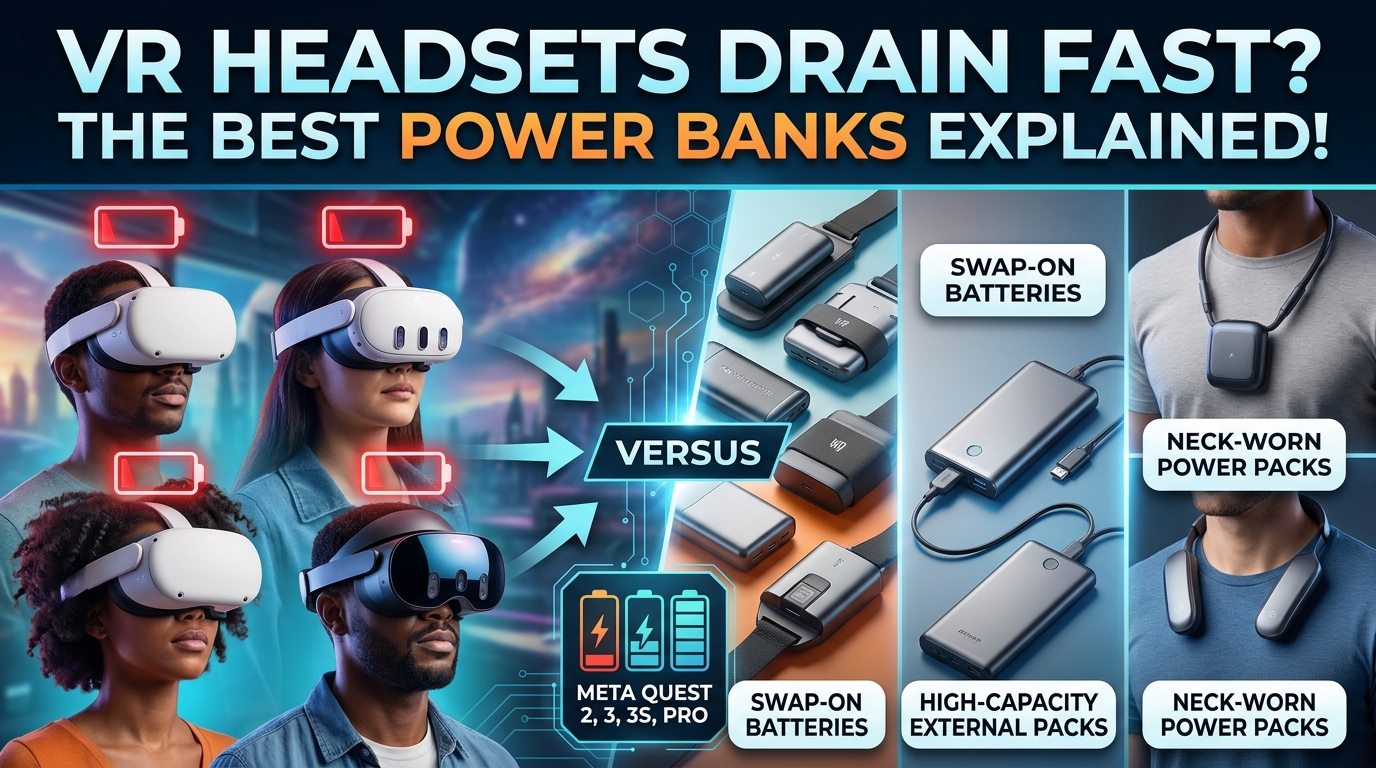
Because of these unique physical requirements, the VR power bank market has split into two distinct form factors, each solving the battery drain problem in a fundamentally different way:
- Headset-Mounted Hot-Swap Systems: Lightweight modular battery pods (5,000mAh each) that clip directly onto the rear of your headset strap. They eliminate dangling cords completely and serve as a rear counterweight, though they require swapping pods mid-session.
- Wearable Neck-Hanging Power Banks: High-capacity single-unit battery packs (10,000mAh) styled like a horseshoe collar around your neck and shoulders. They shift 100% of the battery weight off your skull while providing continuous playtime, requiring a short connecting cable.
Below, we break down the top-tested power banks for Meta Quest headsets in 2026 to help you choose the right form factor for your play style.
Quick Comparison: Best Meta Quest Power Banks
| Product | Form Factor | Capacity | Weight Distribution | Real Playtime Added | Best For | Review Link |
|---|---|---|---|---|---|---|
| KIWI Design P5000 (2-Pack) | Headset-Mounted Hot-Swap | 10,000mAh (2x 5k) | Rear Head Strap (Counterweight) | +4.5 to 5 Hours (Hot-Swap) | Best for Cable-Free Convenience | View Review |
| NEWDERY 10,000mAh Neck Pack | Wearable Neck Collar | 10,000mAh (Single) | Shoulders / Torso (Zero Head Mass) | +3.5 to 5 Hours (Continuous) | Best for Maximum Playtime & Comfort | View Review |
Top VR Power Banks for Meta Quest Reviewed
1. KIWI Design P5000 Power Bank (2-Pack) Best Hot-Swap Cable-Free System
The KIWI Design P5000 2-Pack is engineered specifically for active VR gamers who prioritize total room-scale freedom without wires touching their neck or body. The package includes two 5,000mAh battery pods and a specialized bracket that mounts securely to the back of your Quest 3, 3S, 2, or Pro head strap using magnetic guide rails and a hook-and-loop strap.
Instead of running a wire down to your clothes, the P5000 uses a short right-angle USB-C adapter that plugs cleanly into the side of the headset. Each 100g battery pod delivers 20W fast charging, which is more than enough to maintain or top off the Quest 3 internal battery during heavy processing load.
The signature feature of the P5000 is its hot-swappable modular design. When your active pod runs low after roughly 2 to 2.5 hours, you simply slide it out with one hand and click the second fully charged pod into place. Because you can charge the idle pod while gaming on the active unit, the P5000 system delivers practically endless playtime.
Furthermore, placing a 100-gram battery pod on the rear head strap acts as a ideal counterweight, balancing the front-heavy visor of the Quest headset and reducing pressure on your nose and cheeks.
- Form Factor: Headset-mounted modular pods (2-Pack)
- Capacity: 10,000mAh total (2x 5,000mAh units)
- Max Output: 20W USB-C PD
- Weight Per Pod: ~100g
- Pros: Zero cables around neck/body, hot-swappable for continuous VR, improves head strap balance as a counterweight.
- Cons: Requires managing and recharging two separate pods.
Read our full KIWI Design P5000 Review
2. NEWDERY 10,000mAh Neck-Worn Battery Pack Best High-Capacity Neck Pack
For gamers who want maximum continuous playtime in a single unit without needing to pause for battery swaps, the NEWDERY 10,000mAh Neck-Worn Battery Pack is the top-tier solution. Constructed like an ergonomic U-shaped collar, the NEWDERY rests comfortably over your shoulders and collarbone.
By placing the entire 10,000mAh battery reserve onto your torso, this power bank completely eliminates extra weight from your head. For players prone to neck strain, migraines, or facial soreness from heavy head-mounted accessories, transferring the load to the body makes extended gaming sessions dramatically more comfortable.
The NEWDERY features an 18W Power Delivery (PD) USB-C output port that supplies continuous power to Meta Quest 3, 3S, 2, and PSVR 2 headsets, extending active gameplay by 3.5 to 5 full hours. It also includes a secondary USB-C port, allowing you to charge your smartphone or wireless earbuds simultaneously.
The flexible silicone collar is sweat-resistant and contoured to remain steady whether you are seated in a flight simulator cockpit or standing for room-scale action.
- Form Factor: Wearable neck collar
- Capacity: 10,000mAh
- Max Output: 18W USB-C PD (Dual Ports)
- Weight: ~310g (worn on shoulders)
- Pros: Shifts 100% of battery weight off your head, massive single-unit capacity for 5+ hours, dual charging ports.
- Cons: Requires a short connecting cable running from collar to headset.
Read our full NEWDERY 10,000mAh VR Battery Review
Key Differences: Hot-Swap Head Mounts vs. Wearable Neck Packs
To decide which power bank style best fits your virtual reality setup, consider how you play:
+-------------------------------------------------------------------------+
|                  VR POWER BANK FORM FACTOR TRADEOFF                      |
+------------------------------------+------------------------------------+
| Headset-Mounted (KIWI P5000)       | Wearable Neckband (NEWDERY)        |
+------------------------------------+------------------------------------+
| • 0 Cables on neck or clothes      | • Cable routes from neck to headset|
| • Rear counterweight balances visor| • 100% of battery weight off head  |
| • Hot-swappable (requires 2 pods)  | • Single 10,000mAh unit (no swaps) |
| • Ideal for active room-scale games| • Ideal for sit-down & sim gaming  |
+------------------------------------+------------------------------------+
1. Cable Freedom vs. Single-Plug Simplicity
Headset-mounted systems like the KIWI Design P5000 connect via a rigid 5-inch right-angle USB-C cord that stays locked against the head strap. Nothing touches your body or swings loose, making it the preferred choice for room-scale games involving rapid 360-degree spins, jumping, or fast arm swings.
Neck packs like the NEWDERY 10,000mAh require a cable running from your shoulders up to your side USB-C port. While included cable clips keep it organized against your collar, players who dislike feeling wires during active motion may prefer the head-mounted approach.
2. Weight Counterbalance vs. Total Head Relief
A standalone Quest 3 or Quest 2 is naturally front-heavy, pressing down on your brow. A rear-mounted battery like the KIWI P5000 (~100g) acts as a physical counterweight, shifting the center of gravity back over your head pivot point for better equilibrium.
However, if your neck muscles are sensitive to total head weight, adding any mass to your skull can increase fatigue over long sessions. The NEWDERY neck pack leaves your headset at its stock weight while distributing the battery load across your shoulders.
3. Hot-Swap Playtime vs. Uninterrupted Single Battery
With the KIWI P5000, you get two 5,000mAh pods. While one is powering your headset, the second can sit on a desktop USB charger. When pod #1 drains, you swap them in 5 seconds. This provides theoretically infinite playtime, provided you remember to rotate and charge the idle pod.
The NEWDERY neck pack contains a single massive 10,000mAh cell. You plug in once at the start of your session and get 4 to 5 hours of continuous power without ever taking your hands off the motion controllers.
Power Requirements & Compatibility Across Meta Quest Headsets
Minimum Wattage Requirements
Not all power banks can keep up with VR headsets under load. Standard 5V/2A (10W) power banks are insufficient for Meta Quest 3 and 3S; when plugged into a 10W charger while playing a high-resolution mixed reality title, the headset will still drain its internal battery.
- Meta Quest 3 & Quest 3S: Require at least 18W to 20W USB-C PD output to maintain or increase internal charge level during intense gameplay. Both the KIWI P5000 (20W) and NEWDERY (18W PD) meet this standard.
- Meta Quest 2: Requires 10W to 15W minimum; both featured models exceed this and recharge the Quest 2 rapidly.
- Meta Quest Pro: Consumes 15W to 18W with face/eye-tracking enabled; both models supply stable power.
Headset Compatibility Matrix
| Headset Model | KIWI Design P5000 Compatible? | NEWDERY Neck Pack Compatible? | Recommended Minimum Output |
|---|---|---|---|
| Meta Quest 3 | Yes (Via Included Strap Bracket) | Yes (Universal USB-C) | 18W–20W PD |
| Meta Quest 3S | Yes (Via Included Strap Bracket) | Yes (Universal USB-C) | 18W–20W PD |
| Meta Quest 2 | Yes (Fits Original & Elite Straps) | Yes (Universal USB-C) | 15W PD |
| Meta Quest Pro | Yes (Universal Velcro Mount) | Yes (Universal USB-C) | 18W PD |
| PSVR 2 | N/A (Tethered Console) | Yes (Auxiliary VR Power) | 18W PD |
Final Verdict: Which Meta Quest Power Bank Should You Buy?
Both dedicated VR power banks solve the Quest battery drain problem brilliantly, but cater to different user preferences:
- Choose the KIWI Design P5000 (2-Pack) if you want 100% cable-free mobility, prefer a rear-mounted counterweight for headset balance, and like the convenience of hot-swapping 5,000mAh pods for endless gaming.
- Choose the NEWDERY 10,000mAh Neck Pack if you want zero battery weight on your head, prefer a single massive 10,000mAh battery for 5+ hours of continuous playtime, and don’t mind a short neck-to-headset cable.
Looking to understand more about power bank capacity ratings? Read our guide on what mAh means and how much battery capacity you need.
Found this helpful?
Share this guide with your friends or explore our recommended products.