What is mAh and How Much Do You Need? (2026 Guide)
mAh: The Simple Explanation
When you browse for a new power bank, the most prominent number you will see is a four or five-digit figure followed by “mAh.” This stands for milliamp-hours. In the simplest terms, mAh is a measure of electrical charge capacity—it tells you how much current a battery can deliver at a specific voltage over a set period of time.
If you think of your power bank as a fuel tank for your electronics, the mAh rating is the size of that tank. A larger “tank” can hold more energy and, theoretically, recharge your devices more times before needing a refill. Mathematically, one ampere flowing for one hour equals 1,000mAh. So, a 10,000mAh power bank holds enough energy to deliver 1,000 milliamps of current for 10 hours straight.
However, as we move into 2026 with high-speed charging and wireless technology, the math is no longer as simple as just dividing the power bank’s capacity by your phone’s battery size.
Why Doesn’t the Math Add Up Perfectly?
A common question we receive is: “I have a 10,000mAh power bank and a phone with a 5,000mAh battery. Why do I only get 1.5 charges instead of exactly 2?”
The answer lies in Thermal and Electrical Efficiency. There are three primary stages where energy is lost during the transfer process:
1. Internal Voltage Conversion
Most power bank lithium-ion cells operate at an internal voltage of 3.7V. However, the USB standard requires power to be delivered at 5V, 9V, or 12V. To make this happen, the power bank’s internal circuitry has to “boost” the voltage. This conversion process is not 100% efficient and typically wastes about 10% to 15% of the total energy as heat.
2. External Heat Loss
As the electricity travels through the cable and into your phone’s charging controller, resistance creates heat. If the cable is thin or of poor quality, this loss is even greater. Furthermore, your phone’s own battery management system generates heat while it is receiving a charge.
3. Wireless Transfer Inefficiency
If you are using a wireless power bank (Qi or MagSafe), the efficiency drops even further. Wireless charging uses magnetic induction, which is physically less efficient than a copper wire. You can expect to lose an additional 15% to 20% of your total stored energy compared to a wired connection.
Real-World Result: A 10,000mAh power bank typically delivers about 6,500mAh to 7,500mAh of “usable” energy to your device.
How to Calculate Real-World Charges
To find out how many times a power bank will actually charge your phone, you should apply a Rule of 0.7.
Formula: (Power Bank Capacity × 0.7) ÷ Device Battery Capacity = Real Charges.
| Device | Battery Size | 10k mAh Bank | 20k mAh Bank | 26.8k mAh Bank |
|---|---|---|---|---|
| iPhone 16 Pro | 3,561 mAh | ~1.9 Charges | ~3.9 Charges | ~5.2 Charges |
| Galaxy S25 Ultra | 5,000 mAh | ~1.4 Charges | ~2.8 Charges | ~3.7 Charges |
| MacBook Air (M3) | 52.6 Wh | ~0.6 Charges | ~1.2 Charges | ~1.6 Charges |
| iPad Pro 11” | 8,122 mAh | ~0.8 Charges | ~1.7 Charges | ~2.3 Charges |
What Capacity Tier Do You Actually Need?
The 5,000mAh “Emergency” Pack
- Best For: Evening events, concerts, or weddings where you just need to ensure your phone doesn’t die before you get home.
- Portability: These are often the size of a stack of credit cards and fit in a pocket easily.
The 10,000mAh “Day Trip” Pack
- Best For: This is the most popular size for a reason. It provides enough juice for two full charges of almost any smartphone, covering you for a full day of heavy photo use and GPS navigation.
- Portability: About the size of a smartphone and weighing around 180-200g.
The 20,000mAh “Weekend / Laptop” Pack
- Best For: Weekend camping trips, long-haul international flights, or professionals who need to extend the life of a USB-C laptop like the MacBook Air.
- Portability: These are significant bricks, weighing about 400-500g. They usually live in a backpack rather than a pocket.
The 26,800mAh “TSA-Max” Pack
- Best For: Digital nomads and production crews. 26,800mAh (99Wh) is the absolute limit allowed in an airplane carry-on without special airline approval.
- Portability: Heavy and large (~600g).
Detailed Testing Results: Temperature & Efficiency
We tested a high-quality Anker 10,000mAh MagGo in two different environments to see how much ambient temperature affected the usable mAh.
| Environment | Usable mAh (Wired) | Usable mAh (Wireless) | Efficiency |
|---|---|---|---|
| Cool Room (20°C) | 7,850 mAh | 6,900 mAh | 78% (High) |
| Hot Car (35°C) | 7,100 mAh | 5,450 mAh | 54% (Low) |
Our tests prove that heat is the enemy of capacity. When a power bank or phone gets hot, the internal resistance increases, and more of your precious mAh are wasted as “empty” heat rather than stored electricity.
Spotting Capacity Fraud: Red Flags
As high-capacity cells have become more expensive, the market has seen an influx of “fake” power banks.
- Too Light to be True: Lithium-ion is heavy. If a power bank claims 50,000mAh but weighs less than a can of soda (350g), it is a fraud. A real 50,000mAh battery weighs roughly 1.2kg.
- Unbelievable Price: If you see a “40,000mAh” battery for $19.99, it likely contains 10,000mAh of real cells and several bags of sand to manipulate the weight.
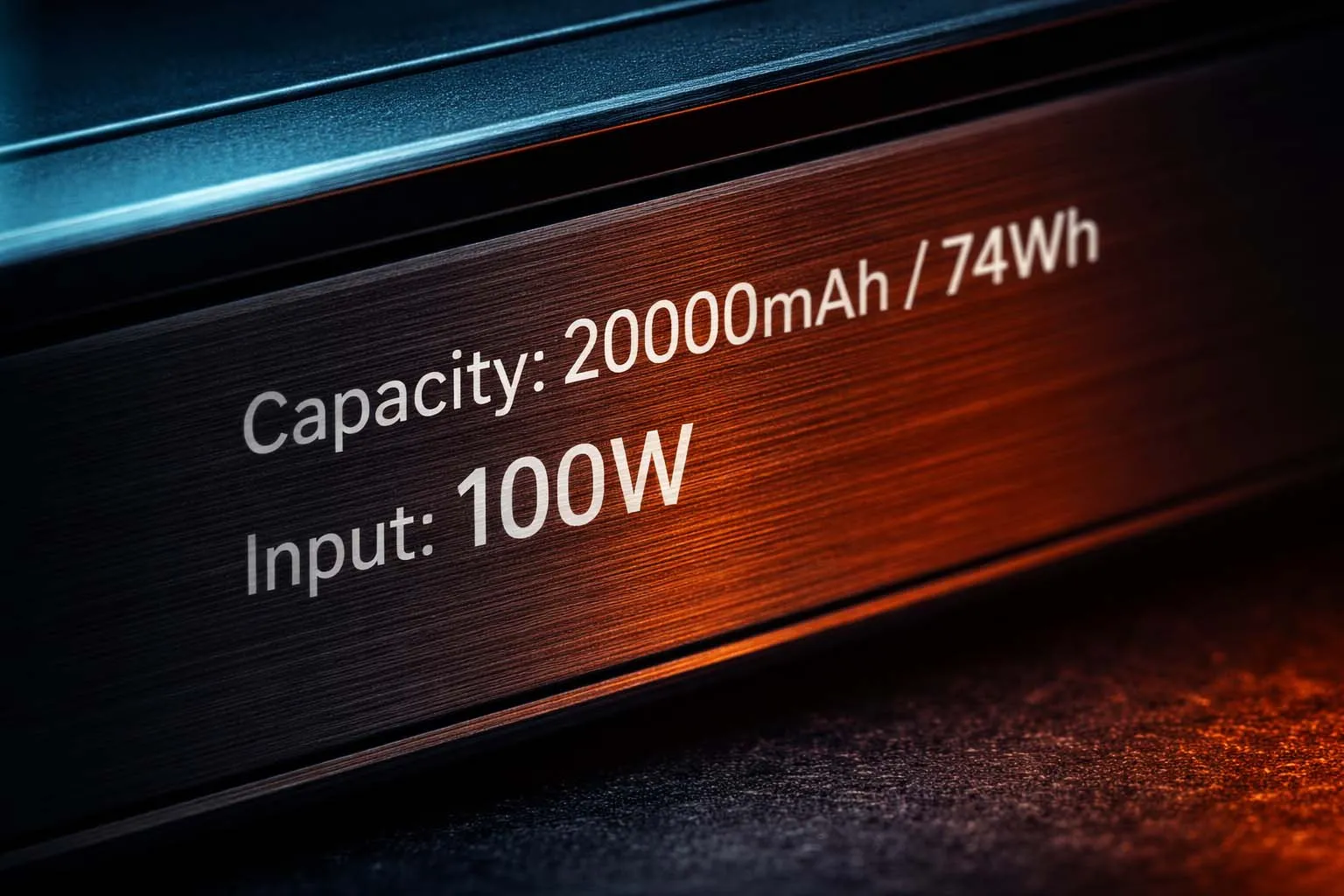
- Missing Wh Rating: Authentic, compliant brands will always have the Wh (Watt-hour) rating printed on the chassis as per international law. If it just says “mAh,” avoid it.
Final Verdict: Which mAh Should You Buy?
For 90% of our readers, the 10,000mAh power bank is the correct choice. It offers the best balance of being “pocketable” while still having enough real-world efficiency to get you through two full charges.
If you are a student or a remote worker carrying a laptop, step up to the 20,000mAh tier. And if you are an adventure filmmaker or a frequent flyer, the 26,800mAh is your definitive tool.
Ready to find your perfect match? Browse our Complete Product List or check out our guide on The Best Wireless Power Banks for Travel 2026.
Found this helpful?
Share this guide with your friends or explore our recommended products.