MagSafe vs Qi2: What is the Difference? (2026)
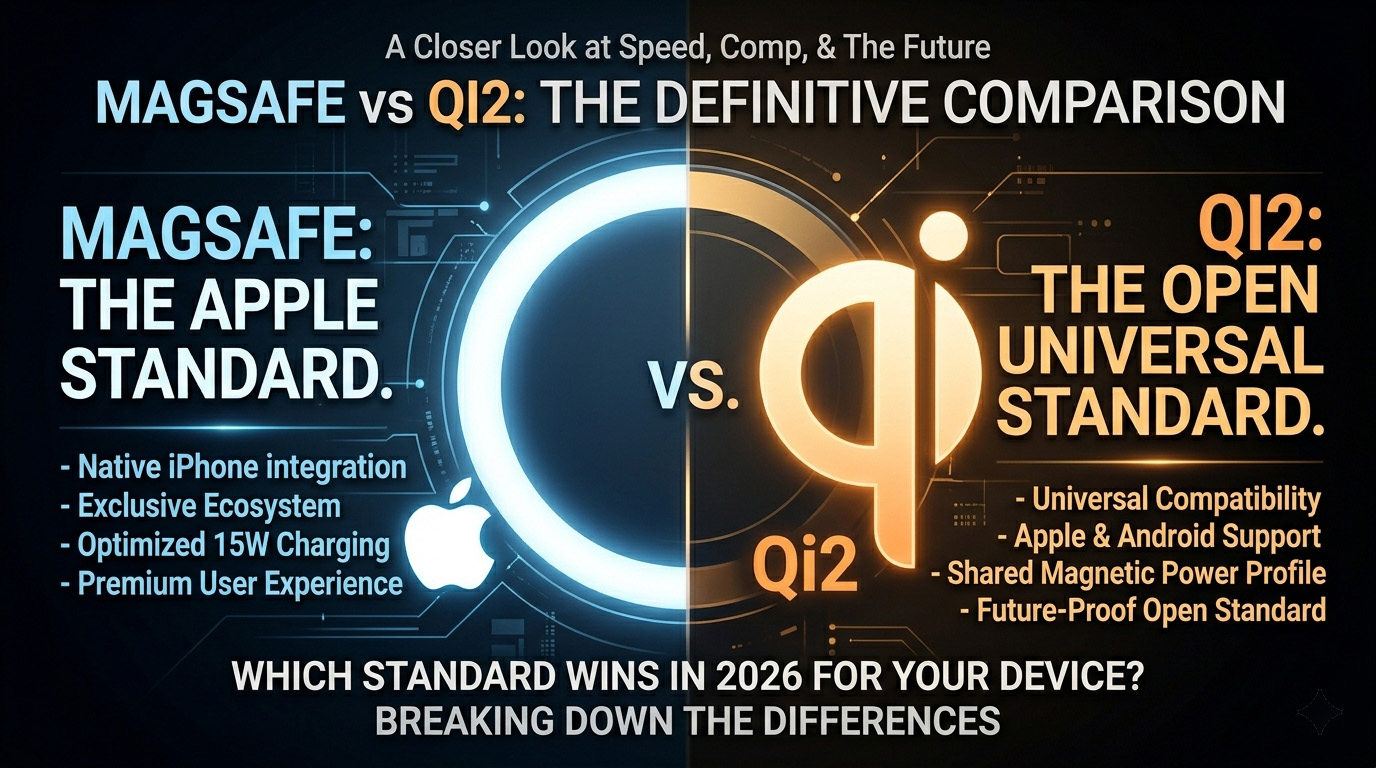
The primary difference between MagSafe and Qi2 is that MagSafe is Apple’s proprietary magnetic charging technology, while Qi2 is a new, open-industry standard built on Apple’s MagSafe technology to bring magnetic alignment and 15W charging to both iPhone and Android devices. In 2026, while they function almost identically for the end user, Qi2 has effectively democratized “MagSafe” by removing the need for expensive proprietary licensing, allowing third-party accessory makers to offer full 15W charging speeds at a lower price point.
Wireless charging has come a long way since the early days of “blind” induction pads where a millimeter of misalignment meant waking up to a dead battery. Today, the battle for the back of your phone is between two giants: Apple’s established MagSafe and the industry-wide Qi2 standard. If you are looking to buy a new wireless power bank or desk charger, understanding the nuances between these two is critical for ensuring you get the fastest, safest, and most efficient charge possible.
In this deep dive, we will break down everything you need to know about the MagSafe vs. Qi2 rivalry, how they evolved, and which one you should choose for your specific device in 2026.
What is MagSafe?
MagSafe for iPhone was introduced in 2020 with the launch of the iPhone 12. While Apple had used the “MagSafe” branding previously for its MacBook chargers, this new iteration was a complete reimagining of wireless charging for mobile devices.
At its core, MagSafe uses a ring of N52 neodymium magnets surrounding a central charging coil. This allows accessories like chargers, wallets, and power banks to snap onto the back of the phone with satisfying precision. This “click” isn’t just about convenience; it solves the biggest problem with the original Qi standard: alignment. By ensuring the charging coils are perfectly centered, energy loss is minimized, heat is reduced, and charging speeds can be safely pushed to 15W.
However, MagSafe is a proprietary Apple ecosystem. To get the full 15W speed, manufacturers had to join the “Made for MagSafe” (MFM) program, which involved paying licensing fees to Apple and using Apple-supplied charging modules. Chargers without this certification were limited to a much slower 7.5W, even if they had magnets.
By 2026, Apple has expanded MagSafe into a massive ecosystem of accessories, and it remains the gold standard for premium iPhone integration. However, the proprietary nature of the technology meant that high-quality, high-speed accessories were often significantly more expensive than their non-magnetic counterparts.
What is Qi2?
Qi2 (pronounced “chee-two”) is the successor to the original Qi wireless charging standard, maintained by the Wireless Power Consortium (WPC). Announced in early 2023, Qi2 was developed with a significant contribution from Apple.
Recognizing that magnetic alignment was the future of wireless power, Apple shared its MagSafe “Magnetic Power Profile” (MPP) with the WPC to serve as the foundation for Qi2. This means that Qi2 is essentially “MagSafe for everyone.” It uses the same ring of magnets and the same basic power delivery profile to ensure that non-Apple devices can enjoy the same efficiency and 15W speeds that iPhone users have had since 2020.
By 2026, Qi2 has become the dominant standard for flagship Android phones and has been fully integrated into the iPhone lineup as well. It represents a rare moment of industry-wide collaboration that benefits the consumer by creating a single, universal charging standard. The WPC’s goal with Qi2 was to unify the fragmented wireless charging market, reducing e-waste and making it easier for consumers to buy chargers that “just work” across all their devices.
Key Differences Between MagSafe and Qi2
While they look and feel the same, several key distinctions remain in 2026:
- Open vs. Proprietary: MagSafe is owned and controlled by Apple. Qi2 is an open standard managed by the WPC. This means anyone can build a Qi2 charger as long as it passes the WPC’s rigorous certification tests.
- Licensing Fees: Manufacturers must pay Apple a premium for “Made for MagSafe” (MFM) certification. Qi2 certification is generally more accessible and cost-effective, leading to cheaper accessories for consumers without sacrificing quality or safety.
- Cross-Platform Support: A “Made for MagSafe” charger is designed specifically for iPhones. While it might charge an Android phone via basic Qi induction, it won’t offer magnetic alignment or high speeds. A Qi2 charger is designed to work at peak performance with iPhones, Samsung Galaxies, Google Pixels, and any other Qi2-certified device.
- The “Tax”: In the early days, you would often see two identical-looking chargers where the MagSafe version cost $20 more than the “magnetic Qi” version. Qi2 has largely eliminated this price gap by providing a high-speed standard that doesn’t require Apple’s proprietary module.
- Certification Labels: Look for the “Qi2” logo on the packaging. Unlike the generic “magnetic charging” labels found on cheap, uncertified gear, the Qi2 logo guarantees that the product has undergone independent laboratory testing for safety and performance.
Speed Comparison
When it launched, both MagSafe and Qi2 were capped at 15W for wireless charging. In the world of wireless power, 15W is the “sweet spot” where you get a reasonably fast charge without generating the extreme heat that can degrade battery health.
However, in 2026, we are seeing some divergence:
- Standard Qi2: Continues to mandate a minimum of 15W for certification, ensuring a consistent experience across all brands. This is roughly twice as fast as the 7.5W “standard” Qi charging that dominated the previous decade.
- Apple’s Evolving MagSafe: With the iPhone 16 and 17 Pro series, Apple has introduced “enhanced MagSafe” which can reach up to 25W when using specific high-wattage power adapters and official MagSafe chargers. This gives Apple users a slight edge in raw speed if they are willing to pay for official first-party gear.
For the average user, the difference between 15W and 25W is noticeable but not always game-changing for a portable power bank. Most Qi2 power banks prioritize efficiency and thermal management over raw peak wattage to protect your phone’s long-term battery health. When you are on the go, a steady 15W charge that doesn’t overheat your phone is often better than a 25W burst that causes the phone to throttle down due to heat.
Magnet Strength Comparison
One of the most frequent questions we get is: “Are Qi2 magnets as strong as MagSafe magnets?”
The answer is yes. Because Qi2 is based on the same Magnetic Power Profile as MagSafe, they use the same N52 neodymium magnet grade and the same circular arrangement. In our testing of 2026 models from brands like Anker and Belkin, we found no discernible difference in “hold strength” between official Apple MagSafe chargers and high-quality Qi2 chargers.
In fact, some third-party Qi2 manufacturers have even started adding stronger magnets than Apple’s default specification to cater to users who use heavy cases or want to mount their phones in high-vibration environments like car dashboards. The physical snapping sensation the “click” is identical. This ensures that accessories like the Anker 621 MagGo stay firmly attached even if you are jogging or moving your phone in and out of a pocket.
Device Compatibility
This is where the transition gets a bit complex. Here is how compatibility stands in 2026:
iPhone Compatibility
- iPhone 12 through 14: These models were built for MagSafe but have received firmware updates to support Qi2 at 15W. This was a huge win for older iPhone users, effectively unlocking faster third-party charging.
- iPhone 15 through 17: These are “Native Qi2” devices. They work perfectly with both MagSafe and Qi2 chargers at 15W (and up to 25W on newer models with specific MagSafe gear).
Android Compatibility
- Samsung Galaxy S25 & S26: These are the first major Samsung flagships to include the magnetic ring natively. They are fully Qi2 compliant, finally giving Samsung users the “snap-on” battery experience.
- Google Pixel 9 & 10: Google has fully embraced Qi2, making these some of the best Android phones for magnetic accessories.
- Older Androids: Can still use Qi2 chargers if you use a “MagSafe compatible” case (which contains the magnetic ring), but the charging speed may be limited to 7.5W or 10W depending on the phone’s internal hardware.
Which is Better for iPhone?
If you are an iPhone user in 2026, the choice usually comes down to price and peak speed.
Choose MagSafe if:
- You want the absolute fastest wireless charging possible (25W) on the latest iPhone 16/17 Pro models.
- You prefer Apple’s aesthetic and integrated “Find My” support in some official accessories.
- You are already heavily invested in the Apple Store ecosystem.
Choose Qi2 if:
- You want 15W speeds (which is plenty for most people) at a much better price point.
- You want a power bank that you can also share with friends who have Android phones.
- You want more variety in form factors, such as the Belkin BoostCharge Pro Qi2 which features a more versatile kickstand than many Apple-branded options.
For most people, a Qi2-certified power bank is the smarter buy because it offers the same 15W experience as MagSafe for a fraction of the cost.
Which is Better for Android?
For Android users, Qi2 is the undisputed winner.
Before Qi2, Android users had to use clunky “magnetic stickers” or specific cases to try and mimic the MagSafe experience. Even then, the charging was often slow and inefficient because the phone’s internal software didn’t “trust” the third-party magnetic attachment. With Qi2 now built into flagship Android phones, you finally get the seamless “snap and charge” experience with guaranteed 15W speeds.
There is no reason for an Android user to look specifically for “MagSafe” branded gear unless they already happen to own a legacy MagSafe-compatible case. Look for the Qi2 logo to ensure the best possible performance and safety features like Foreign Object Detection (FOD).
Our Verdict: The End of the “MagSafe Tax”
The arrival of Qi2 in 2024 and its total market saturation by 2026 is one of the best things to happen to mobile tech. It has effectively ended the “MagSafe tax,” where iPhone users had to pay a premium just to get a decent wireless charge.
Today, whether you have an iPhone or a high-end Android, the recommendation is simple: Buy Qi2. It is a universal, open, and high-performance standard that ensures your devices stay charged efficiently and safely. The peace of mind that comes with a certified product knowing it won’t overheat your battery or fail to align is worth the small investment over cheap, uncertified magnetic chargers.
Comparison Table: MagSafe vs. Qi2
| Feature | Apple MagSafe | WPC Qi2 (MPP) |
|---|---|---|
| Standard | Proprietary (Apple) | Open (Industry Standard) |
| Max Speed (2026) | Up to 25W (Latest iPhones) | 15W (Standard) |
| Magnet Standard | N52 Magnetic Ring | N52 Magnetic Ring (MPP) |
| Compatibility | iPhone 12+ | iPhone 13+ & Modern Androids |
| Price Premium | High (Licensing Fees) | Low to Moderate |
| Availability | Apple Store & MFM Partners | Everywhere |
Power Banks That Support These Standards
If you’re ready to upgrade your portable charging setup, these are the top-rated power banks in 2026 that support these magnetic standards. We have tested each for thermal efficiency, magnet strength, and real-world capacity.
1. Anker MagGo Power Bank (10K, Qi2 Display)
Anker was the first to market with a comprehensive Qi2 lineup. This 10,000mAh monster features a smart digital display that tells you exactly how much charging time you have left. It is the perfect example of why Qi2 is better than old MagSafe chargers it offers more features for a better price while still hitting that 15W limit.
2. Mophie Snap+ Juice Pack Mini
For those who want a slim, lightweight option that feels like part of the phone, Mophie’s Snap+ series is legendary. While it started as a MagSafe-compatible line, the 2026 versions are fully Qi2 certified, ensuring they work perfectly with the latest Samsung and Google phones as well as iPhones. Its premium fabric finish remains a fan favorite.
3. Belkin BoostCharge Pro Wireless 10K (Qi2)
Belkin’s partnership with Apple means their engineering is top-tier. This Qi2 model offers 15W speeds and a very sturdy kickstand, making it ideal for watching videos or taking FaceTime calls while your phone charges. It’s the ultimate travel companion for long flights or train rides.
4. Anker 621 MagGo (5000mAh)
If you want something that disappears into your pocket, the Anker 621 is the way to go. It’s ultra-slim and uses the latest magnetic profile to stay securely attached to your phone even in a crowded bag or pocket. While it has half the capacity of its larger siblings, its portability is unmatched for daily commutes.
FAQ: Your MagSafe and Qi2 Questions Answered
Is Qi2 as fast as MagSafe?
For most devices, yes. Both standards deliver 15W of wireless power. However, the newest iPhone 16 and 17 Pro models can reach 25W using official Apple MagSafe chargers and a 30W+ power adapter. For the average user, the 15W provided by Qi2 is more than sufficient for daily use.
Can Qi2 chargers work with iPhone?
Absolutely. Every iPhone from the 13 series and up fully supports Qi2. Older MagSafe iPhones (12 series) will work with Qi2 chargers but might not always hit the full 15W speed due to hardware limitations in those early magnetic coils.
Is MagSafe better than Qi2?
In 2026, MagSafe is only “better” if you own the latest Pro iPhone and want the absolute maximum 25W peak speed. For everyone else, Qi2 is functionally identical, offers better cross-device compatibility, and is usually much better value for money.
Do Android phones support MagSafe?
Technically, no. MagSafe is an Apple brand. However, modern Android phones like the Galaxy S25 and Pixel 10 support Qi2, which uses the exact same magnetic technology. So, while they don’t have “MagSafe,” they have the universal equivalent that works with all the same magnetic accessories.
Summary: Future-Proof Your Charging
As we look toward the rest of 2026 and beyond, the distinction between MagSafe and Qi2 will continue to blur. For the consumer, this is a win. We finally have a world where one power bank can charge an iPhone, a Samsung, and a Pixel all at high speeds with perfect magnetic alignment.
Before you make your next purchase, be sure to read our full guide on how wireless charging works and our deep dive into what Qi2 certification actually means for your specific device. If you are looking for the best performance, always look for the Qi2 logo and stick with reputable brands like Anker, Mophie, and Belkin.
Charging shouldn’t be complicated. With Qi2 and MagSafe, the future is magnetic, efficient, and finally, universal. Don’t settle for uncertified “magnetic” chargers that risk your phone’s battery health invest in the standard that was built for the next decade of mobile power.
Found this helpful?
Share this guide with your friends or explore our recommended products.