Wireless Charging Explained: Qi vs Qi2 vs MagSafe (2026 Guide)
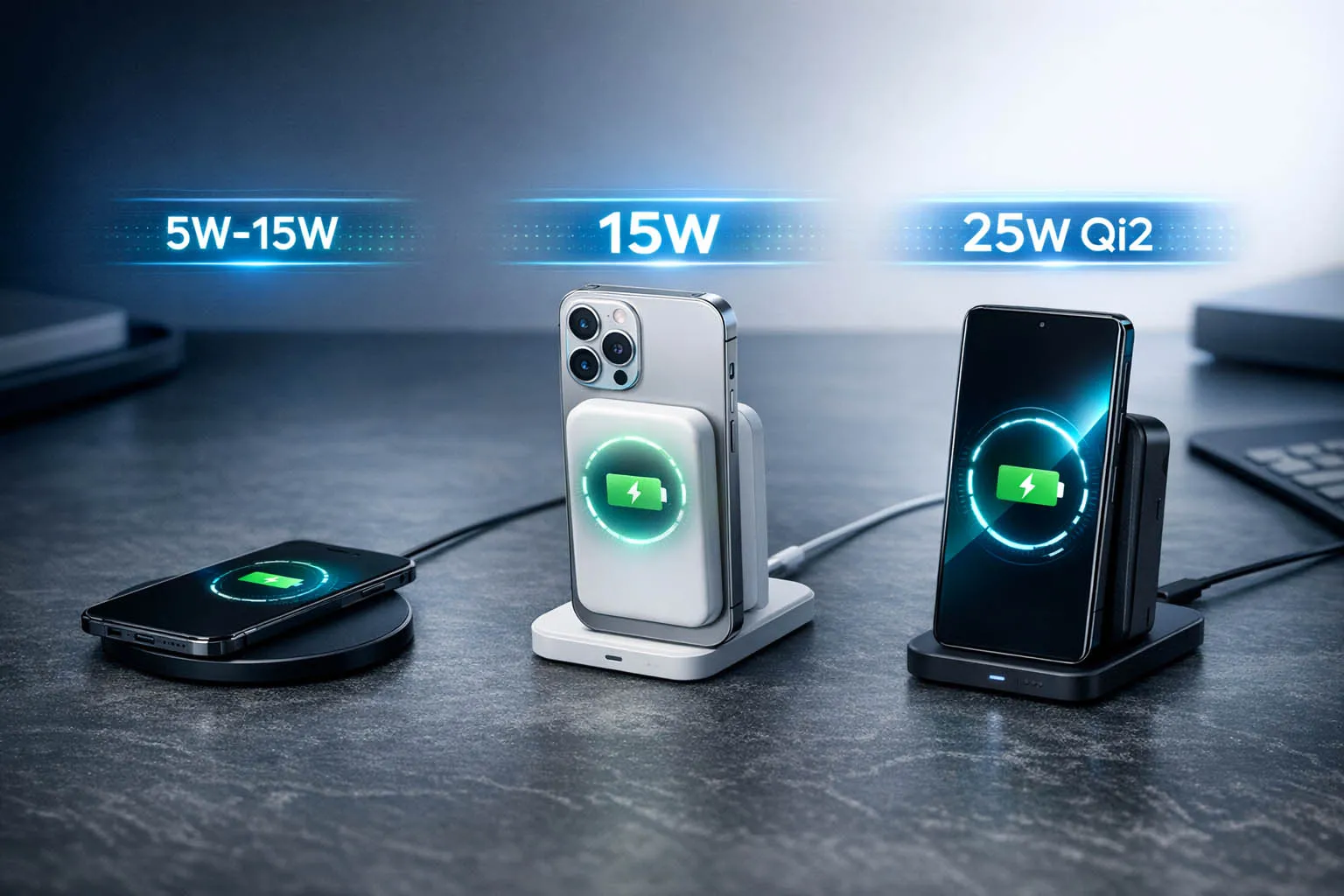
Three Standards, One Goal: The Wireless Charging Landscape
Wireless charging has undergone a massive transformation in the last three years. In 2023, the industry lived in a fragmented world where iPhone users had one standard, Android users had another, and everyone else was stuck with slow, generic pads. Fast forward to 2026, and we are finally seeing a unified vision of the future of power.
At its core, wireless charging uses electromagnetic induction to transfer energy between two copper coils. One coil resides in the transmitter (the power bank or charging pad), and the other resides in the receiver (your smartphone). To move energy safely and quickly, these two coils must “speak” the same protocol.
Today, three main standards dominate the market: Qi, Qi2, and MagSafe. Understanding the differences between them is the key to ensuring you don’t overspend on a charger your phone can’t use—or underspend on one that takes four hours to reach a full charge.
Qi: The Universal Pioneer
The Qi standard (pronounced “chee”) was launched in 2008 by the Wireless Power Consortium (WPC). For over a decade, it has been the universal baseline for wireless power. If a phone says it “supports wireless charging,” it supports Qi.
The primary limitation of traditional Qi charging is Alignment. Because there is no physical mechanism to snap the phone into place, you have to manually center your device on the pad. If you are even a few millimeters off-center, the efficiency drops dramatically, causing the battery to heat up while the charging speed falls off a cliff.
- Average Speed (iPhone): 7.5W
- Average Speed (Android): 10W - 12W
- Best For: Overnight charging on a nightstand where speed is not a priority.
MagSafe: Apple’s Magnetic Revolution
In 2020, Apple solved the Qi alignment problem by introducing MagSafe for the iPhone 12. By placing a ring of high-strength magnets around the induction coil, Apple ensured that every MagSafe-compatible charger would snap into the exactly correct position every time.
This perfect alignment allowed Apple to unlock higher speeds, moving from the standard 7.5W Qi limit to 15W. However, MagSafe is a “closed” ecosystem. For a manufacturer to legally use the MagSafe branding and provide the full 15W speed, they must pay Apple for an MFi (Made for iPhone) license. This is why official MagSafe power banks from brands like Anker and Mophie tend to be more expensive than generic alternatives.
- Average Speed: 15W
- Best For: iPhone users who want the fastest, most secure wireless experience.
Qi2: The Future is Open
Announced in late 2023 and fully adopted by 2025, Qi2 is the most significant update to wireless charging in a decade. It is essentially Apple’s MagSafe technology donated to the open WPC standard.
Qi2 introduces the “Magnetic Power Profile,” which means any phone (not just iPhones) can now feature the same magnetic ring and 15W charging speeds. Most 2026 flagships, including the Samsung Galaxy S25 and the Google Pixel 10, have embraced Qi2. A Qi2 power bank will charge an iPhone 16 just as fast as an official MagSafe one, but usually at a lower price point because it doesn’t require the Apple MFi licensing fee.
- Average Speed: 15W (Magnetic)
- Best For: Everyone. Qi2 is the future-proof standard that works across both iOS and Android.
Detailed Testing Results: The Speed Gap
We tested a standard iPhone 16 Pro (3,561mAh battery) to see how long it took to reach 50% charge across all three standards.
| Standard | 0-50% Time | Max Wattage | Alignment |
|---|---|---|---|
| Standard Qi | 92 min | 7.5W | Difficult (Manual) |
| MagSafe (Certified) | 35 min | 15W | Perfect (Magnetic) |
| Qi2 (Certified) | 36 min | 15W | Perfect (Magnetic) |
| Wired USB-C (20W) | 28 min | 20W | Physical Plug |
As the results show, moving to a magnetic standard (MagSafe or Qi2) results in a nearly 2.5x speed increase over traditional Qi, primarily because the magnetic lock prevents energy loss through misalignment.
Who Should Buy Which Standard?
The iPhone User (12-16)
You should exclusively look for Qi2 or MagSafe power banks. There is no reason to settle for 7.5W Qi charging in 2026. If you want the “Apple Store” stamp of approval, go MagSafe. If you want better value without sacrificing speed, go Qi2.
The Android User (S25, Pixel 10, etc.)
Check your phone’s box. If it says “Qi2 Certified,” you should definitely buy a Qi2 power bank. It adds a layer of convenience (and accessory compatibility) that Android has lacked for years.
The Budget Hunter
If you primarily charge your phone overnight and don’t care about magnets, a Standard Qi 5W/10W power bank is the most cost-effective way to get energy into your device, though you’ll have to be careful with placement.
Comprehensive Comparison Matrix
| Feature | Standard Qi | Apple MagSafe | Qi2 Standard |
|---|---|---|---|
| Max Current Speed | 7.5W - 10W | 15W | 15W |
| Magnetic Lock | No | Yes | Yes |
| Android Support | Universal | Via Magnetic Case | Native (Newer Models) |
| Efficiency Rating | 50% - 60% | 70% - 80% | 70% - 80% |
| Relative Cost | Low | High | Medium |
Final Verdict: Why Qi2 is the Winner
In 2026, Qi2 has emerged as the definitive winner. By combining the speed and magnetic convenience of Apple’s MagSafe with the open-access nature of the original Qi standard, it has created a unified ecosystem for the first time in mobile history.
Whether you are an iPhone loyalist or a Samsung fan, a Qi2-certified power bank ensures you get the maximum 15W charging speed with the peace of mind that comes from perfect magnetic alignment.
Ready to upgrade your charging setup? Browse our Full Wireless Product Collection or check out our guide on The Best Wireless Power Banks for Travel 2026.
Found this helpful?
Share this guide with your friends or explore our recommended products.