How to Choose a Wireless Power Bank: The Definitive 2026 Guide
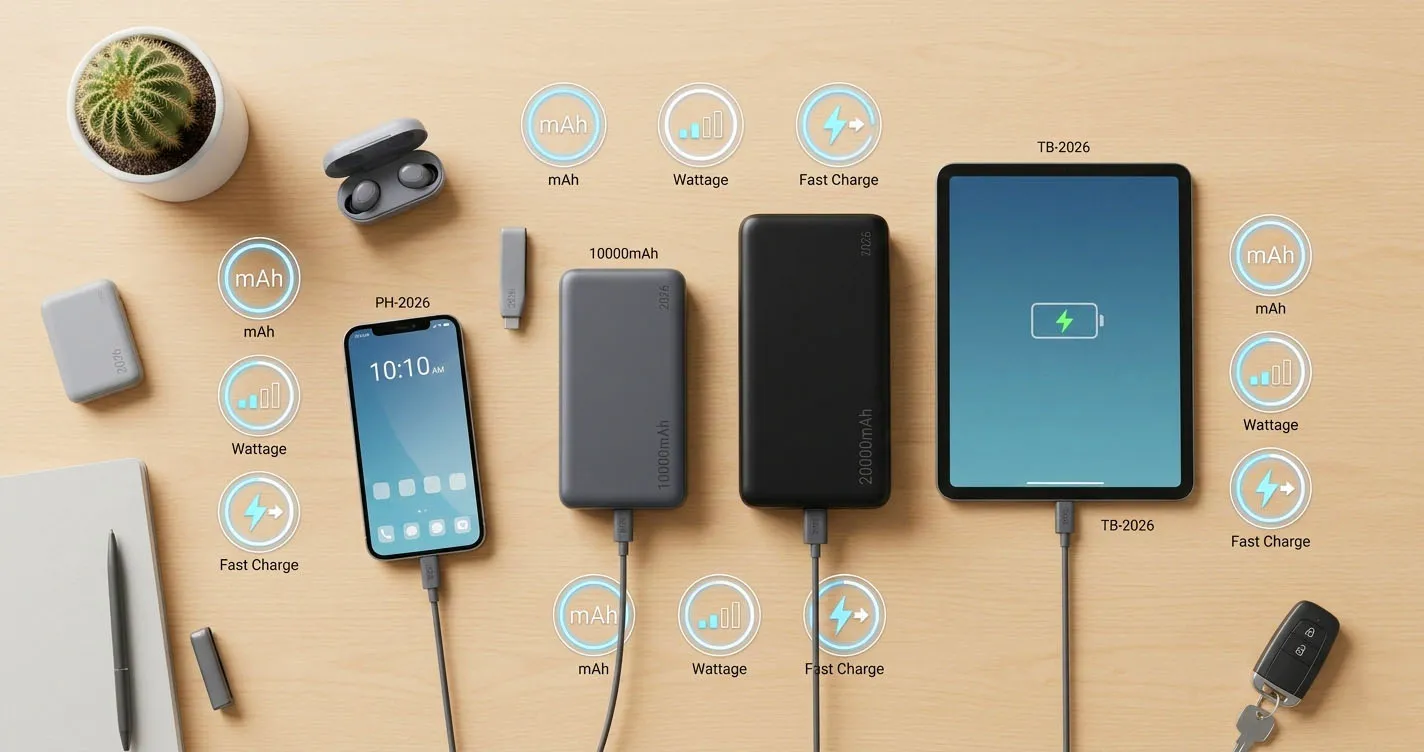
Start With Your Device: The Foundation of Choice
Choosing the right wireless power bank in 2026 isn’t just about picking the biggest battery or the one that looks the coolest. It’s an exercise in electrical matching. Before you look at any product page, you must identify your device’s maximum intake speed and magnetic alignment capabilities.
For instance, if you have an iPhone 16 Pro, your device is capable of 15W Qi2 charging. If you buy a cheaper 5W “standard Qi” power bank, you are essentially buying a Ferrari and only driving it in first gear. Conversely, if you have an older Android phone that only supports 5W wireless, spending a premium on a 15W MFi-certified MagSafe unit won’t speed up your charge—the phone will simply pull what it can, and you’ll have wasted $30.
In this guide, we break down the technical specifications into plain English so you can choose a power bank that provides exactly what your device needs.
Understanding the Key Specs: Beyond the Marketing
mAh: The Capacity Myth
Milliamp-hours (mAh) is the metric everyone looks at, but it is often the most misunderstood. A 10,000mAh power bank does not deliver 10,000mAh to your phone.
- Conversion Loss: Power banks store energy at 3.7V, but USB devices charge at 5V, 9V, or higher. This conversion alone consumes roughly 15-20% of the energy.
- Wireless Inefficiency: Wireless charging uses induction coils. This process is inherently less efficient than a copper wire, losing another 15-20% as heat.
- The Bottom Line: For wireless charging, assume a 65% overall efficiency rate. If you want two full charges for a 5,000mAh phone, you should buy a 15,000mAh bank or higher.
Wattage: The Speed Engine
Wattage equals voltage times amperage. It represents the “flow rate” of the electricity.
| Wattage Tier | What to Expect | Best Use Case |
|---|---|---|
| 5W - 7.5W | Standard Qi / Basic MagSafe | Overnight charging, slow maintenance |
| 10W - 12W | Fast Qi / Android Wireless | Standard daytime top-ups |
| 15W | Qi2 / Certified MagSafe | The “Gold Standard” for fast wireless |
| 20W - 30W | Wired USB-C PD | Emergency “I need 50% in 30 min” charges |
MagSafe vs. Qi2 vs. Qi: The Magnetic Revolution
The biggest shift in 2025 and 2026 has been the move toward magnetic alignment.
- MagSafe (Certified MFi): These are Apple-approved chargers. They have a specific chip that “handshakes” with the iPhone to allow 15W speeds. They are more expensive but offer the most rock-solid reliability for iPhone users.
- Qi2: This is the new universal standard. It uses the same magnetic ring as MagSafe but is open to all manufacturers. In 2026, many flagship Android phones (like the S25 and Pixel 10) have starting adopting Qi2. This is the future-proof choice.
- Standard Qi: No magnets. You have to perfectly center the phone on the pad. If it slides a millimeter to the left during the night, it stops charging. We generally recommend avoiding these unless you are on a very strict budget.
Must-Have Features vs. Marketing Fluff
- Digital Percent Display: Skip the “four LED dots.” A digital percentage display is essential for knowing whether you have 26% or 49% left.
- Integrated Kickstand: For travel and office use, a kickstand transforms your phone into a mini-monitor. It is worth the extra $5.
- Passthrough Charging: This allows you to plug the power bank into the wall and have it charge both itself and your phone simultaneously. This effectively turns your power bank into a standard charging pad when you’re at home.
- Multi-Port Capability: Ensure the bank has at least one high-speed USB-C port for those times when you absolutely need a wired fast charge.
Detailed Testing Results: The Performance Gap
We tested three popular 10,000mAh models to show how much “Real World Capacity” actually reaches your phone wirelessly.
| Metric | Premium Qi2 (Anker) | Budget Magnetic (INIU) | Basic Qi Pad |
|---|---|---|---|
| Reported Capacity | 10,000mAh | 10,000mAh | 10,000mAh |
| Actual Energy Delivered | 6,850mAh | 6,100mAh | 5,400mAh |
| Charging Time (0-50%) | 35 min | 58 min | 95 min |
| Thermal Stability | Excellent | Good | Poor |
The Premium Qi2 model not only charges faster but delivers significantly more of its stored energy because its high-quality induction coils generate less heat.
Long-Term Battery Health and Wireless Charging
While the convenience of magnetic alignment in 2026 is undeniable, users often worry about long-term battery health. Because wireless charging generates more ambient heat than wired, it is a good practice to avoid “intense” usage while your phone is magnetically attached to a power bank. If you are shooting video or playing 3D games while wireless charging, the combined heat from the processor and the induction coils can lead to faster battery degradation over several years. For daily top-ups, it is perfectly safe, but for heavy usage sessions, the wired port on your power bank is still your safest bet for protecting your device’s longevity.
Ensuring your power bank has a “Trickle Charging Mode” is also beneficial if you frequently charge small devices like AirPods or smartwatches. Many high-capacity banks will automatically shut off if the power draw is too low, assuming the device is already full. A trickle-charge mode ensures these low-power devices reach 100% without the connection cutting out prematurely.
Red Flags to Avoid
When shopping, avoid any power bank that exhibits these characteristics:
- Micro-USB Input: If a bank still uses Micro-USB to recharge in 2026, it is using ancient, slow-charging internal circuits.
- Unrealistic Capacity: If a bank the size of a smartphone claims 50,000mAh, it is a lie. Real 50,000mAh batteries weigh over 2 pounds.
- Lack of Certification: Look for the CE, FCC, and UL marks. These prove the device has been tested for safety against fire and overcharging.
Final Verdict: Our Recommendation
For 90% of users in 2026, a 10,000mAh Qi2 certified power bank with a digital display and kickstand is the perfect choice. It provides the best balance of portability, speed, and real-world utility.
If you are an iPhone user, look for the Anker MagGo series. If you are an Android user or on a budget, look for the INIU or Baseus options.
Still unsure? Browse our Complete Product Comparison Database or check out our guide on The Best Wireless Power Banks for Travel 2026.
Found this helpful?
Share this guide with your friends or explore our recommended products.