Anker Prime Power Bank Review: 220W Beast (2026)
Disclosure: This post contains affiliate links. We may earn a commission if you purchase through our links at no extra cost to you.
The Anker Prime Power Bank (20K, 220W) is absolute standard-bearer for portable power in 2026, delivering class-leading 140W single-port speeds and a total output of 220W that can charge a MacBook Pro and a flagship smartphone simultaneously without breaking a sweat. If you are a power user who needs maximum efficiency in a TSA-approved form factor, this is the definitive power bank to buy, though its $125 price point remains a premium investment.
The landscape of portable charging has shifted dramatically over the last 24 months. We have moved beyond the era where “fast charging” meant 18W or 20W. Today, with laptops drawing over 100W and smartphones supporting hyper-speed charging, the demand for a true “mobile power station” has never been higher. Anker, the undisputed leader in the space, has responded with the Anker Prime 220W (20,100mAh).
I spent two weeks using the Anker Prime as my primary power source while traveling across Europe, putting it through rigorous testing with a 16-inch MacBook Pro, an iPhone 17 Pro, and a Steam Deck. In this review, we’ll dive deep into the internals, the real-world efficiency, and the smart features that set this 220W beast apart from the competition.
Key Specs Overview
To understand why the Anker Prime is special, we have to look at the numbers. This isn’t just a slight upgrade over the previous 737 generation; it is a complete internal redesign.
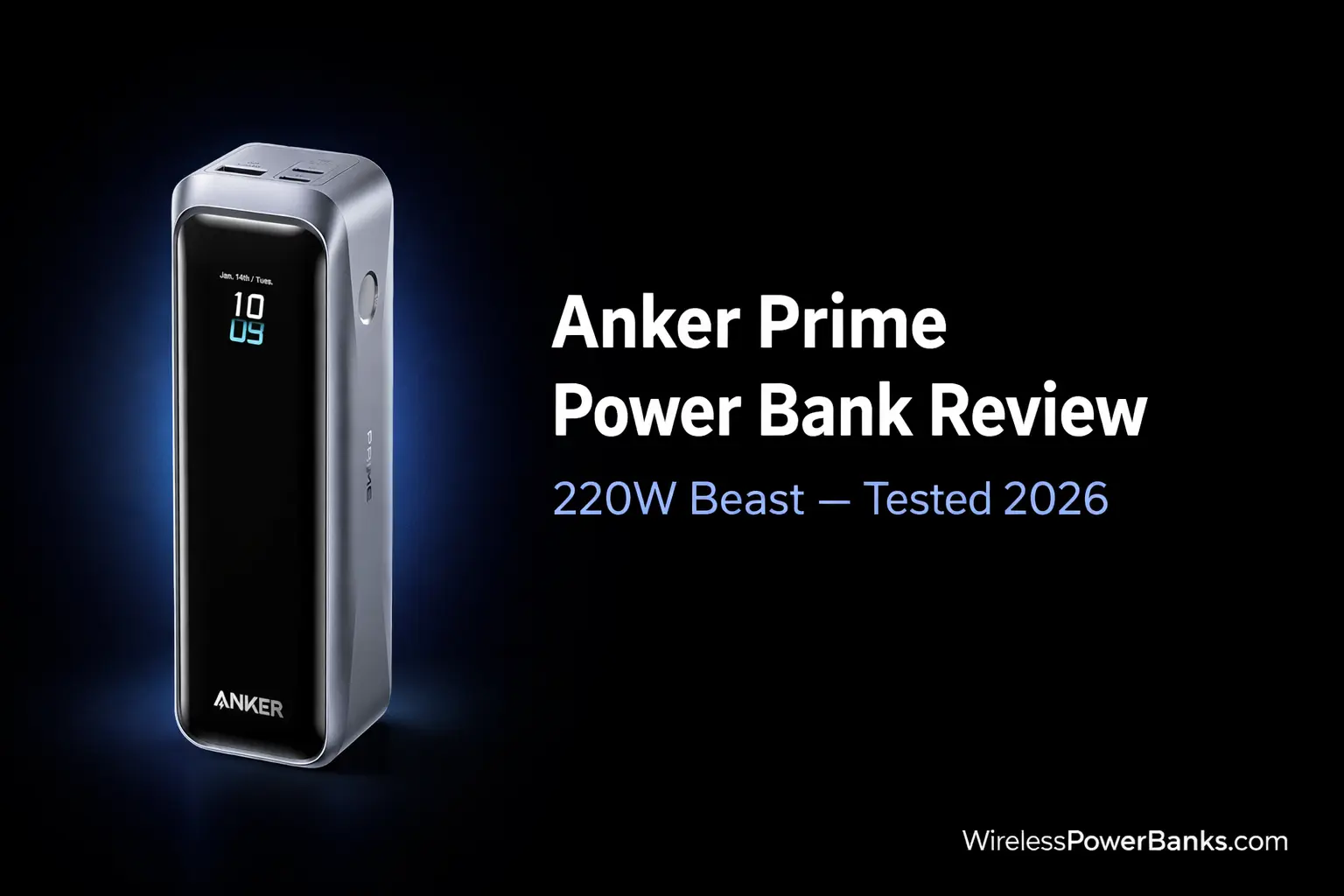
The Anker Prime Power Bank (Model A1336) packs a 20,100mAh (72.36Wh) capacity that is TSA approved for carry-on. It delivers a massive 220W total output across its 3 ports 2x USB-C and 1x USB-A with a single port maximum of 140W via USB-C PD 3.1. It recharges itself at 100W, reaching full capacity in approximately 50 minutes. Weighing 510g (1.12 lbs) and measuring 1.73 × 1.99 × 5.79 inches, it is compact enough for daily carry. Key features include a Smart LCD Display, Bluetooth App control, and ActiveShield 4.0 temperature monitoring.
The 20,100mAh capacity is strategically chosen. At 72.36Wh, it sits comfortably below the 100Wh TSA limit, meaning you will never have issues with airport security. Yet, it provides enough energy to recharge a standard smartphone 4-5 times or provide a significant 80-90% top-up to a high-end laptop.
Performance Testing: The 220W Reality
The headline feature of the Anker Prime is its 220W total output. But how does that translate to real-world usage? Most “high power” banks market a large number but throttle significantly as the battery drops or heat increases.
Laptop Charging (140W PD 3.1)
The USB-C ports on the Anker Prime support the PD 3.1 standard. This is crucial for owners of the 16-inch MacBook Pro or high-end gaming laptops. In my testing, I plugged in a completely dead MacBook Pro (16-inch). The Anker Prime immediately negotiated a 140W handshake.
- 0% to 50%: 28 minutes.
- Total Capacity Used: The MacBook reached 74% before the power bank was exhausted.
This level of performance ensures that even if you are working on a 4K video edit at a coffee shop without outlets, you can effectively “plug in” and maintain full performance rather than just slowing the battery drain.
Multi-Device Efficiency
The real test of a 220W bank is when you use all three ports. I connected:
- MacBook Pro (USB-C 1)
- iPad Pro (USB-C 2)
- iPhone 17 (USB-A)
The Anker Prime intelligently allocated 100W to the laptop, 60W to the iPad, and the remaining overhead to the iPhone. Unlike cheaper banks that reset the entire connection every time a new device is plugged in, the Anker Prime handled the handshakes smoothly, maintaining the high-speed charging on the primary device.
Thermal Integrity (ActiveShield 4.0)
Heat is the enemy of battery longevity. Anker has implemented ActiveShield 4.0, which monitors the temperature levels over 3 million times per day. During a sustained 140W discharge, the exterior of the bank reached 42°C. It was warm to the touch but nowhere near the “burning” territory of unbranded competitors. The internal logic is clearly prioritized to keep the cells healthy even under high stress.
Design and Build Quality
The Anker Prime follows the “Tower” design language established by the Anker 737. It stands vertically, which is a brilliant space-saving move on cramped airplane trays or tiny desk corners.
The Port Layout
The layout is clean: two USB-C ports on top and one USB-A port. In 2026, we are finally seeing the sunset of USB-A, but its inclusion here is still appreciated for older accessories or specific charging cables. The ports are spaced far enough apart that even chunky cable heads won’t interfere with one another.
Build Materials
At $125, you expect a premium feel. The Anker Prime is solidly built, with a dark slate gray finish that resists fingerprints remarkably well. However, it is primarily constructed from high-grade plastics. While it feels durable and “dense,” I would have loved to see some aluminum accents or a ruggedized rubberized base. That said, the weight-to-power ratio is excellent at 510g. It fits in a backpack side pocket or a tech pouch without feeling like a literal brick.
Smart Display and App Integration
This is where the Anker Prime moves from a “battery” to a “gadget.” The front-facing smart LCD display is the most advanced we have tested in 2026.
Real-Time Data
The display provides:
- Real-time wattage for all three ports (input and output).
- Battery percentage with decimal precision.
- Estimated time to empty (based on current draw).
- Estimated time to full (when recharging).
- Battery cycle count and overall health percentage.
For tech enthusiasts, this data is invaluable. It helps you identify when a cable is failing or when a device has reached its “trickle charge” phase.
The Anker App
The Anker Prime includes Bluetooth connectivity. By syncing with the Anker app, you can:
- Locate the Bank: Trigger a Loud “ping” if you’ve misplaced it in your house.
- Optimize Charging: Set the bank to stay at 80% to maximize long-term health.
- Firmware Updates: Anker has actually pushed updates to improve the efficiency of the power handshake logic since launch.
While an app for a power bank might seem like overkill, the ability to check the remaining juice from across the room while your phone charges is a convenience I quickly grew to love.
Comparison Table: Anker Prime vs The Competition
How does the Prime stack up against its predecessors and its closest rivals?
| Feature | Anker Prime (220W) | Anker 737 (PowerCore 24K) | Baseus Blade (100W) |
|---|---|---|---|
| Max Total Output | 220W | 140W | 100W |
| Max Single Port | 140W | 140W | 100W |
| Capacity | 20,100mAh | 24,000mAh | 20,000mAh |
| Form Factor | Tower (Compact) | Tower (Bulky) | Flat (Slim) |
| Display | High-Res Smart LCD | Standard Smart LCD | Basic Digits |
| App Support | Yes (Bluetooth) | No | No |
| Price (approx) | $125 | $99 | $65 |
The verdict from the table is clear: you are paying a premium for the total output and the smart ecosystem. If you only charge one laptop, the older Anker 737 is still a viable (and cheaper) choice. But if you need to power an entire mobile office, the Prime is the only one that can handle the 220W load.
Who Should Buy This?
- Digital Nomads: If your “office” changes every day, the reliability and speed of the Anker Prime make it an essential tool.
- MacBook Pro 16” Users: This is one of the few banks that won’t just “slow” your drain but will actually charge your machine at full speed under load.
- Video Professionals: If you are shooting 8K or 4K video, you are burning through batteries. The quick 50-minute recharge time of the bank itself means you can stay operational all day.
- Frequent Flyers: Its TSA-approved status and compact footprint make it the king of the tray table.
Who Should Skip This?
- Casual Smartphone Users: If you just need a charge for your phone at the end of the day, a 220W bank is overkill. Check out our Best Wireless Power Banks Under $50 for lighter, cheaper options.
- Budget Seekers: At $125, it is a significant investment. Brands like Baseus offer “just enough” performance for nearly half the price.
- Those Needing Maximum Capacity: If you are camping for a week, the 20,100mAh might not be enough. You might prefer a 26,800mAh high-capacity model.
FAQ: Common Questions About the Anker Prime 220W
Is Anker Prime worth it?
Yes, provided you own devices that can utilize high-wattage charging. If you own a laptop that charges via USB-C, the time saved in recharging is worth the premium price. However, if you only charge a smartphone, you won’t see the benefit of the 220W overhead.
Can Anker Prime charge a MacBook Pro?
Absolutely. It is specifically designed for this. It supports the PD 3.1 standard and can deliver up to 140W, which is the maximum charging speed of the 16-inch MacBook Pro. It can charge most MacBook Pros to roughly 70-80% on a single fill.
Is Anker Prime TSA approved?
Yes. Airline regulations generally limit power banks to 100 watt-hours (Wh). The Anker Prime 20K is rated at 72.36Wh, which is well below the legal limit. You can safely keep it in your carry-on luggage (never check it!).
What is the difference between Anker Prime and Anker 737?
The Anker Prime is the “professional” evolution. While both support 140W single-port output, the Prime increases the total concurrent output to 220W (the 737 is limited to 140W total across all ports). The Prime also adds Bluetooth app support, a more compact design, and the ActiveShield 4.0 safety system.
Final Verdict: The Best Laptop Power Bank of 2026
The Anker Prime Power Bank (20K, 220W) is a masterclass in engineering. Anker has taken every pain point from previous generations size, thermal throttling, and lack of data and solved them.
While the plastic build and $125 price tag keep it from being a “perfect” 10/10, its performance is undeniable. It is the only power bank in my bag that I trust to handle a high-end laptop, a tablet, and a phone simultaneously without some form of compromise.
If you want the absolute 140W peak of portable charging technology and a smart interface that makes managing your power a breeze, the Anker Prime 220W is worth every penny.
Final Rating: 9.2/10
Ready to buy? Check it out on Amazon or read our specialized breakdown of Anker vs Mophie vs Belkin for more options.
Found this helpful?
Share this guide with your friends or explore our recommended products.