5000mAh vs 10000mAh Power Bank: Which Do You Need?
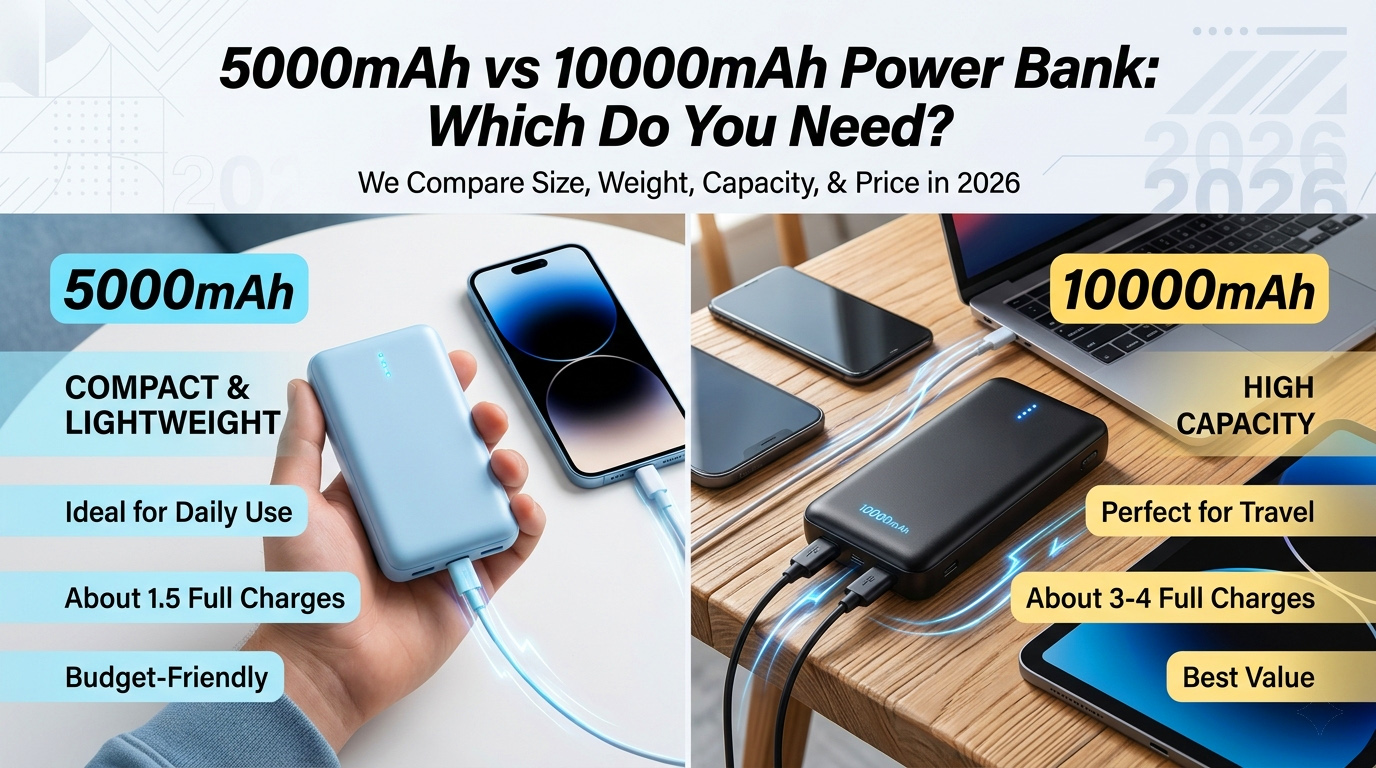
If you are looking for the direct answer: a 10,000mAh power bank is the best choice for most people in 2026 because it provides 1.5 to 2 full charges for modern flagship smartphones, making it ideal for a full day of heavy use or travel. However, a 5,000mAh power bank is the superior option if you prioritize portability and only need an emergency “cushion” to get your phone through the final hours of the day without adding significant bulk to your pocket.
Choosing between a 5000mAh and a 10000mAh power bank is the most common dilemma for shoppers looking at portable chargers. On one hand, you want enough power to ensure your device never dies; on the other, you don’t want to carry a “brick” in your pocket that makes your sleek smartphone feel twice as heavy. In 2026, the technology has advanced to the point where both sizes are more efficient than ever, but the fundamental trade-off remains: capacity vs. portability. In this comprehensive guide, we will break down the technical differences, real-world performance, and specific use cases to help you decide which capacity is right for your daily carry.
What Does mAh Mean?
To understand the difference between these two sizes, we first need to look at the terminology. The term “mAh” stands for milliampere-hour. It is a unit that measures electric charge over time, effectively representing the energy capacity of a battery. Think of it like the size of a fuel tank in a car: the higher the mAh, the more “fuel” (energy) the battery can hold.
However, the “tank size” isn’t the only factor. How efficiently that fuel is used depends on the voltage and the device you are charging. Most power banks use lithium-ion cells with a nominal voltage of 3.7V. To charge a smartphone via USB, the power bank must convert that internal 3.7V to a standard 5V (or higher for fast charging, such as 9V or 12V via Power Delivery). This conversion process leads to energy loss, which we will discuss in more detail later.
It is also important to distinguish between Capacity and Output. Capacity (mAh) tells you how much total energy is stored, while Output (Watts) tells you how fast that energy can be pushed into your phone. A 5,000mAh power bank with 20W output will charge your phone much faster than a 10,000mAh power bank limited to 10W, even though the latter has more “total” energy.
If you want a deeper dive into the science of battery capacity, check out our full article on what is mAh explained. For now, the key takeaway is that more mAh equals more potential runtime for your devices.
How Many Charges Does Each Give?
The most frequent question users ask is: “How many times will this charge my phone?” While the math seems simple, real-world results differ from theoretical numbers due to efficiency loss.
The 5,000mAh Reality: The Emergency Cushion
A 5,000mAh power bank is designed for “top-ups.” It is the safety net that ensures you don’t get stranded with a dead battery.
- iPhone 16 / 17 Pro: You can expect roughly 0.8 to 0.9 charges. This means it will take a dead phone to about 85-90%.
- iPhone 16 / 17 Pro Max: Because these phones have massive internal batteries, a 5K pack will only give you about 65% to 70%.
- Samsung Galaxy S25 / S24 Ultra: Since these devices have large 5,000mAh internal batteries, a 5,000mAh pack will typically provide a 60% to 70% boost.
The 10,000mAh Reality: The Reliable Workhorse
A 10,000mAh power bank is the “gold standard” for reliability. It is the size most power users gravitate toward.
- iPhone 16 / 17 Pro: You will get approximately 1.6 to 1.8 full charges. This is enough to charge your phone from 0% to 100% once, and still have nearly another full charge left for later in the day.
- iPhone 16 / 17 Pro Max: You can expect roughly 1.2 to 1.3 full charges.
- Samsung Galaxy S25 / S24: You can expect roughly 1.3 to 1.5 charges.
It is important to remember that as phones get more powerful and their internal batteries get larger, the relative value of a 5,000mAh pack decreases. In 2026, 5,000mAh is no longer a multi-day solution; it is a “get home safely” solution.
Size and Weight Comparison
This is where the 5,000mAh models shine. The primary reason to choose a smaller capacity is portability.
Portability and Daily Carry
- 5,000mAh Power Banks: These are often referred to as “ultra-slim” or “mini” chargers. They typically weigh between 120g and 140g (about 4.5 ounces). In terms of thickness, many modern 5K packs are only 0.3 to 0.45 inches thick. They are roughly the size of a deck of cards or even a stack of credit cards. You can leave one attached to your phone via MagSafe or Qi2 and still fit the whole package into a jeans pocket comfortably.
- 10,000mAh Power Banks: Doubling the capacity requires doubling the physical battery cells. These units usually weigh between 220g and 260g (8 to 9 ounces). They are also significantly thicker, often measuring 0.7 to 0.9 inches. While they are still “pocketable” in a jacket or a bag, they are noticeably bulky when attached to the back of a phone. Carrying a 10K pack attached to your phone feels like holding two phones stacked together.
Ergonomics
Ergonomics are often overlooked. When using a magnetic power bank, you are physically holding the battery while using your phone. A 5,000mAh pack is light enough that you might forget it’s there. A 10,000mAh pack, however, significantly changes the center of gravity of your phone, which can lead to wrist fatigue during long scrolling sessions or gaming.
Price Comparison
In 2026, the price gap between 5,000mAh and 10,000mAh has narrowed significantly, but it remains a factor for budget-conscious shoppers.
- 5,000mAh Units: These typically range from $25 to $45. Premium models with Qi2 fast charging or luxury materials (like leather or fabric) sit at the higher end.
- 10,000mAh Units: These typically range from $40 to $80. The higher price point usually includes extra features like digital displays, built-in kickstands, and higher-wattage USB-C ports (often 20W to 30W).
When you look at the cost-per-mAh, 10,000mAh power banks almost always offer better value. You are often paying only 30-40% more money for 100% more battery capacity. However, if you never actually use that extra capacity, the lower price of the 5K model is the smarter financial move.
The Efficiency Loss: Why 10000mAh Doesn’t Give 10000mAh
One of the most misunderstood aspects of portable chargers is the “Usable Capacity.” If you buy a 10,000mAh power bank, you might be disappointed to find that it only seems to put about 6,500mAh into your phone. This isn’t a scam it’s physics.
There are three main reasons for this energy loss:
- Voltage Conversion (The Big One): Power bank internal cells operate at 3.7V. However, smartphones charge at a minimum of 5V. To boost that voltage from 3.7V to 5V, the power bank’s internal circuitry must perform a DC-to-DC conversion. This process is about 85-90% efficient, meaning energy is immediately lost as heat.
- Circuit Resistance: The internal wiring, the charging controller, and even the USB-C cable itself have resistance. As electrons flow through them, some energy is dissipated as heat.
- Chemical Efficiency: Lithium-ion batteries are not 100% efficient at releasing their stored energy. Factors like ambient temperature and the speed of discharge (fast charging creates more heat) affect how much energy actually leaves the cells.
As a general rule of thumb, you should assume a 65% to 70% efficiency rate.
- A 5,000mAh pack provides about 3,250mAh to 3,500mAh of actual usable power.
- A 10,000mAh pack provides about 6,500mAh to 7,000mAh of actual usable power.
This is why, if you have a phone with a 5,000mAh internal battery, a 5,000mAh power bank will never give you a 100% charge. It simply doesn’t have enough usable energy after the “physics tax” is paid.
5000mAh vs 10000mAh Comparison Table
| Feature | 5000mAh Power Bank | 10000mAh Power Bank |
|---|---|---|
| Charges for iPhone (Pro) | ~0.8 to 0.9 | ~1.6 to 1.8 |
| Charges for Samsung (S-Series) | ~0.6 to 0.7 | ~1.3 to 1.5 |
| Weight | 120g - 140g | 220g - 260g |
| Size (Thickness) | ~0.45 inches (Ultra-slim) | ~0.80 inches (Compact-thick) |
| Price Range | $25 - $45 | $40 - $80 |
| Best For | Daily commute, nights out, minimalist EDC | Travel, long flights, heavy workdays, power users |
Best Use Cases for 5000mAh
A 5,000mAh power bank is a specialized tool for specific lifestyles. It is not meant to be your only source of power for a weekend away; rather, it is a “battery extension” for your phone.
The Minimalist Commuter
If you work a standard 9-to-5 shift and find your phone is at 15% by the time you head to the train, a 5K pack is perfect. It adds just enough juice to get you home comfortably while you use Spotify or check emails, without making your pockets feel heavy.
Nights Out and Social Events
If you are going to a concert, a wedding, or a festival where you’ll be taking hundreds of photos and videos, a 5,000mAh magnetic pack is ideal. Because it is so light, you can keep it attached to the phone while you use the camera, and it won’t feel like you’re holding a heavy brick that ruins the shot.
Small Phone Users
If you use a compact phone like the standard iPhone 16 or a smaller Google Pixel, a 10K pack might actually block your camera lenses or overhang the bottom of the phone. A 5K pack is designed to fit the footprint of smaller devices perfectly, maintaining the sleek aesthetic of your phone.
Best Use Cases for 10000mAh
A 10,000mAh power bank is the “all-rounder” and the most popular choice for a reason. If you could only own one power bank, this should be it.
Travelers and Digital Nomads
On a long-haul flight or a day of navigating a new city with GPS, a 5K pack will run out before lunch. A 10K pack ensures you have power from morning until late at night, even with heavy screen usage. For more on this, see our guide to the best travel power banks.
Heavy Mobile Gamers and Creators
If you play mobile games (like Genshin Impact or Call of Duty Mobile), edit high-resolution video on the go, or use your phone as a mobile hotspot, your battery will drain at an alarming rate. A 10K pack is mandatory to keep up with these high-drain activities.
Multi-Device Charging
Most 10,000mAh power banks come with multiple ports and enough “overhead” to charge two things at once. You can wirelessly charge your phone while using a USB-C cable to juice up your AirPods or a friend’s phone simultaneously.
Real World Examples: Seeing the Difference
To see these differences in action, let’s look at two of the most popular and highly-rated models currently on the market from Anker.
The 5,000mAh Example: Anker 621 (MagGo 5K)
The Anker 621 is the gold standard for minimalist design. It is roughly the thickness of a smartphone and features a sleek, rounded aesthetic that feels premium in the hand. It uses Anker’s proprietary “MiniCell” technology to shrink the internal components. While it only provides about 0.8 charges for a Pro-sized iPhone, its “disappear-in-your-pocket” portability makes it a favorite for office workers. It doesn’t have a kickstand or a screen, but it does its one job extending your battery life with style and reliability.
The 10,000mAh Example: Anker MagGo 10K (Qi2)
The Anker MagGo 10K represents the cutting edge of 10,000mAh technology in 2026. Not only does it double the capacity of the 621, but it also adds significant functionality. It features a built-in folding kickstand and a smart digital display that shows you the exact percentage of battery remaining and the estimated time to full charge. Most importantly, it is fully Qi2 certified, allowing for 15W wireless charging twice as fast as the 7.5W output of the 621. While it is twice as thick, many users find the trade-off worth it for the faster speed and the convenience of the kickstand.
Advanced Considerations: Charging Longevity and Pass-Through
When choosing between these two sizes, you should also consider how often you’ll be charging the power bank itself.
Charging Cycles
Every battery has a finite number of “charge cycles” (usually 300 to 500) before its capacity starts to permanently degrade.
- With a 5,000mAh power bank, you will likely be draining it to 0% and recharging it to 100% every single day. This means you will hit those 500 cycles much faster.
- With a 10,000mAh power bank, you might only use 50% of it in a day. This effectively doubles the lifespan of the device because you aren’t putting as much stress on the internal cells.
Pass-Through Charging
This is a feature that allows the power bank to charge your phone while the power bank itself is plugged into the wall. Many high-end 10,000mAh models support this, effectively turning the power bank into a wireless charging stand at night. Because 5,000mAh models are designed for portability, they often lack the sophisticated thermal management required for safe, long-term pass-through charging.
Which Should You Buy? The Final Verdict
The choice ultimately comes down to your lifestyle and phone usage patterns.
Choose a 5,000mAh power bank if:
- You hate carrying heavy things and want the thinnest possible device.
- You usually have access to a wall outlet at work or home and just need an emergency backup.
- You want a charger that can stay attached to your phone while you take photos or text comfortably.
- You own a smaller smartphone and want a battery that matches its footprint.
Choose a 10,000mAh power bank if:
- You travel frequently, go on long hikes, or spend full days away from a wall charger.
- You use your phone for intensive tasks like GPS navigation, gaming, or video recording.
- You want the best “bang for your buck” and don’t mind a little extra thickness.
- You own a large phone (Pro Max or Ultra) which requires a significant amount of energy to recharge.
- You want advanced features like digital displays, kickstands, and Qi2 15W fast charging.
Frequently Asked Questions (FAQ)
Is 5000mAh enough for a day?
For most people, yes. If you start the day with a 100% charged phone, a 5,000mAh power bank provides enough “extra” juice to keep you going through a standard workday and a long commute. However, if you are a heavy user who spends hours on TikTok or Instagram, or if you are traveling and using GPS constantly, you may find 5,000mAh runs out before the sun goes down.
How many times can 10000mAh charge an iPhone?
A 10,000mAh power bank will typically charge an iPhone 16 or 17 Pro about 1.7 times. For the larger Pro Max models, which have bigger internal batteries, you can expect roughly 1.3 to 1.4 full charges.
Is a bigger power bank always better?
Not necessarily. While more capacity is great, a bigger power bank is heavier and bulkier. If you buy a massive 20,000mAh “brick” but only ever use 2,000mAh of it, you are carrying unnecessary weight every day that can lead to hand fatigue. The “best” power bank is the one that provides exactly as much power as you need while remaining as portable as possible for your specific use case.
What is the best mAh for travel?
For air travel and general tourism, 10,000mAh is widely considered the “sweet spot.” It is large enough to provide peace of mind for an entire day of travel (including flights, layovers, and finding your hotel) but small enough to meet all TSA regulations and fit easily into a small “personal item” bag, purse, or backpack.
Conclusion
In the battle of 5000mAh vs 10000mAh, there is no single winner only the right choice for your specific needs. In 2026, the 10,000mAh power bank has become the industry standard for a reason: it offers the perfect balance of capacity, features, and value. It is the safe choice for almost everyone.
But for those who value aesthetics, minimalism, and a lightweight pocket, the 5,000mAh power bank remains a brilliant piece of engineering that solves the battery anxiety problem without compromising the slim feel of a modern smartphone.
Before you click “buy,” take a look at your phone’s battery health and your daily habits. If you often find yourself glancing nervously at a 10% battery icon at 4 PM, go for the 10K. If you just want a little extra security “just in case” you miss your train, the 5K will serve you perfectly.
Found this helpful?
Share this guide with your friends or explore our recommended products.